

Commercial asphalt paving is the paving of lots, drives and loading areas that carry customer cars, delivery trucks and the public every working day. In New Orleans, three things set it apart from a driveway: heavier axle loads, a city stormwater rule and federal accessibility standards.
Federal Highway Administration research found that pavement wear rises far faster than the load on it. Doubling an axle load can increase the damage by a factor of roughly 8 to 16, and one delivery truck is not the same as a few more cars.
A business lot also has to move a lot of water in a hurry, and in New Orleans a larger project can fall under the city’s stormwater code. On top of that, the accessible spaces have their own rules for width and slope.
At TurnKey Asphalt, we pave driveways, parking lots and commercial surfaces across the New Orleans metro, and we plan a lot around what will actually cross it.
If you manage a lot that needs paving or a reseal, contact us and we will look at it and put our recommendation in writing.
This guide walks through what the federal and city sources say about loads, rain and accessibility, and what each one changes on the pavement.
Why Do Delivery Trucks Wear a Parking Lot Faster Than Cars?
Pavement does not wear in a straight line with weight. The FHWA explains that most pavement break-up comes from fatigue, which is damage built up by many repeated loads.
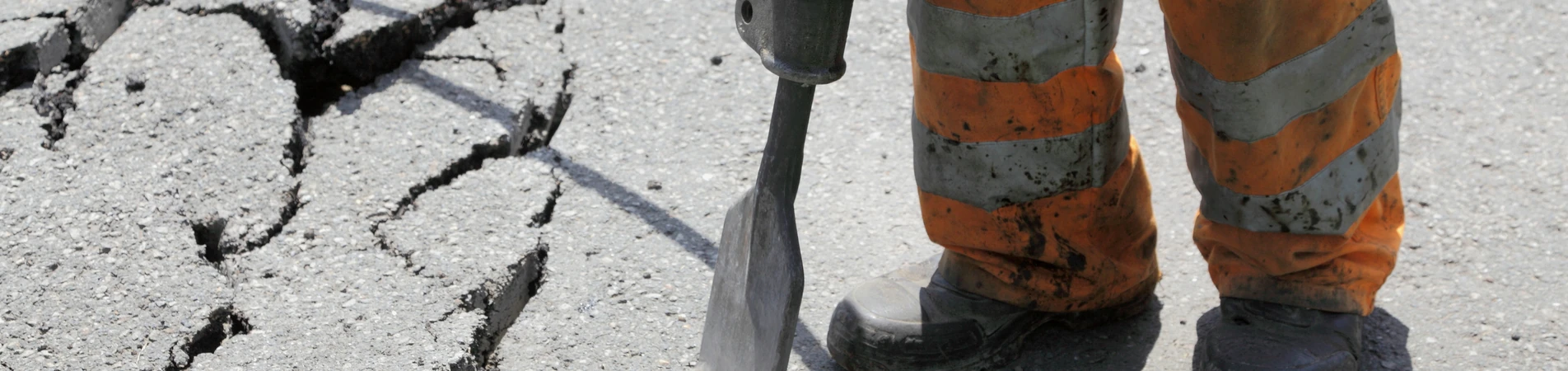
The heavier each load, the fewer passes it takes to crack the surface. The FHWA adds that, especially on a thin pavement, one very heavy load can break it up in the two wheel paths.
The yardstick engineers use is an 18,000-pound single axle with dual tires. Every other axle is compared against it.
The famous AASHO Road Test of the late 1950s found that damage grew roughly with the fourth power of the load. Doubling an axle from 10,000 to 20,000 pounds raised the impact on the pavement about 16 times.
Later research cited by the FHWA puts the relationship closer to the third power for most kinds of damage. Even then, doubling the axle load means about eight times the wear. Either way, weight counts far more than the number of vehicles.
Federal rules show how heavy a legal truck can be. Under 23 CFR 658.17, which covers the Interstate System and reasonable access to it, a single axle can carry up to 20,000 pounds, a tandem axle up to 34,000 pounds and the whole vehicle up to 80,000 pounds.
A lot built for customer cars sees nothing close to that. A lot with a grocery dock, a dumpster pickup or a fuel delivery sees it every week, usually on the same path from the entrance to the back of the building.
How Is a Commercial Lot Built to Carry That Weight?
The answer starts before any asphalt arrives. The lot has to be specified for its heaviest regular traffic, then laid and compacted so it holds up to that traffic.
Depth Set by What Crosses It
Our asphalt paving page says it directly: depth follows the traffic the surface actually carries, not a single figure applied to every job. A car driveway and a lot taking loaded delivery vehicles are not paved the same way.
That is why we ask what crosses the lot, how often and where. A truck route to the loading area and a row of customer spaces can need different depths on the same property.
Compacted While It Is Still Hot
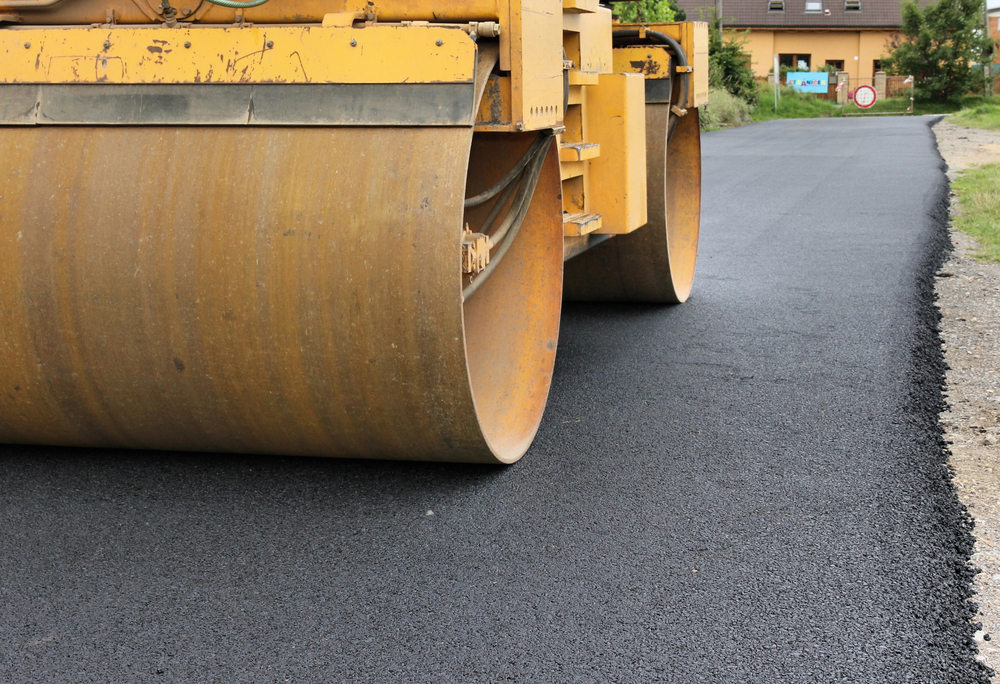 Compaction is only possible while the asphalt is hot. It is what turns loose mix into a dense surface that sheds water instead of soaking it up.
On a commercial job, joints between paving passes and the edges are worked last. That leaves no open seam for water to get in, which matters because the FHWA notes that pavement moisture speeds up the cracking that loads cause.
Where Loads Stand Still
Moving traffic is only half of it. Standing weight deforms a surface more readily than moving weight, so a truck idling at a dock or a dumpster sitting on its pad presses on the same spot for hours.
Those are the places where ruts and dents show up first. On an older lot, they are often the first sign the base is tiring, as our post on why Hammond parking lots crack, rut and hold water shows in detail.
What Does New Orleans Rain Ask of a Parking Lot?
A parking lot is a large, hard surface, and every drop that lands on it has to go somewhere. NOAA’s Atlas 14 estimates for New Orleans put a one-hour storm of about 2.03 inches at roughly once a year on average. The 10-year one-hour storm is about 3.34 inches.
On a one-acre lot, 2.03 inches is about 7,370 cubic feet of water, or roughly 55,000 gallons, in a single hour by our math. The 10-year storm over a full day, about 8.33 inches, works out to roughly 226,000 gallons on that same acre.
The City of New Orleans regulates that runoff. In 2018 it replaced Article 23 of the Comprehensive Zoning Ordinance with a Stormwater Code in Chapter 1, Section 121 of the Building Code.
The city says its post-construction requirements apply to new development or redevelopment, other than smaller residential properties, with 5,000 square feet or more of impervious surface or a site of one acre or more.
Those projects must retain or detain, and filter, the first 1.25 inches of runoff from each rain event and limit how fast water leaves the site. On a 5,000-square-foot lot, that first 1.25 inches comes to roughly 3,900 gallons.
The Department of Safety and Permits decides whether a plan is required when the building permit is submitted. These are City of New Orleans rules; a lot in another parish follows that parish’s requirements.
For the paving itself, the job is the same everywhere: levels that carry water to the drains instead of leaving it to sit. Our guide to how proper asphalt drainage helps prevent long-term damage explains why standing water shortens the life of a surface.
What Do the ADA Standards Require on the Pavement?
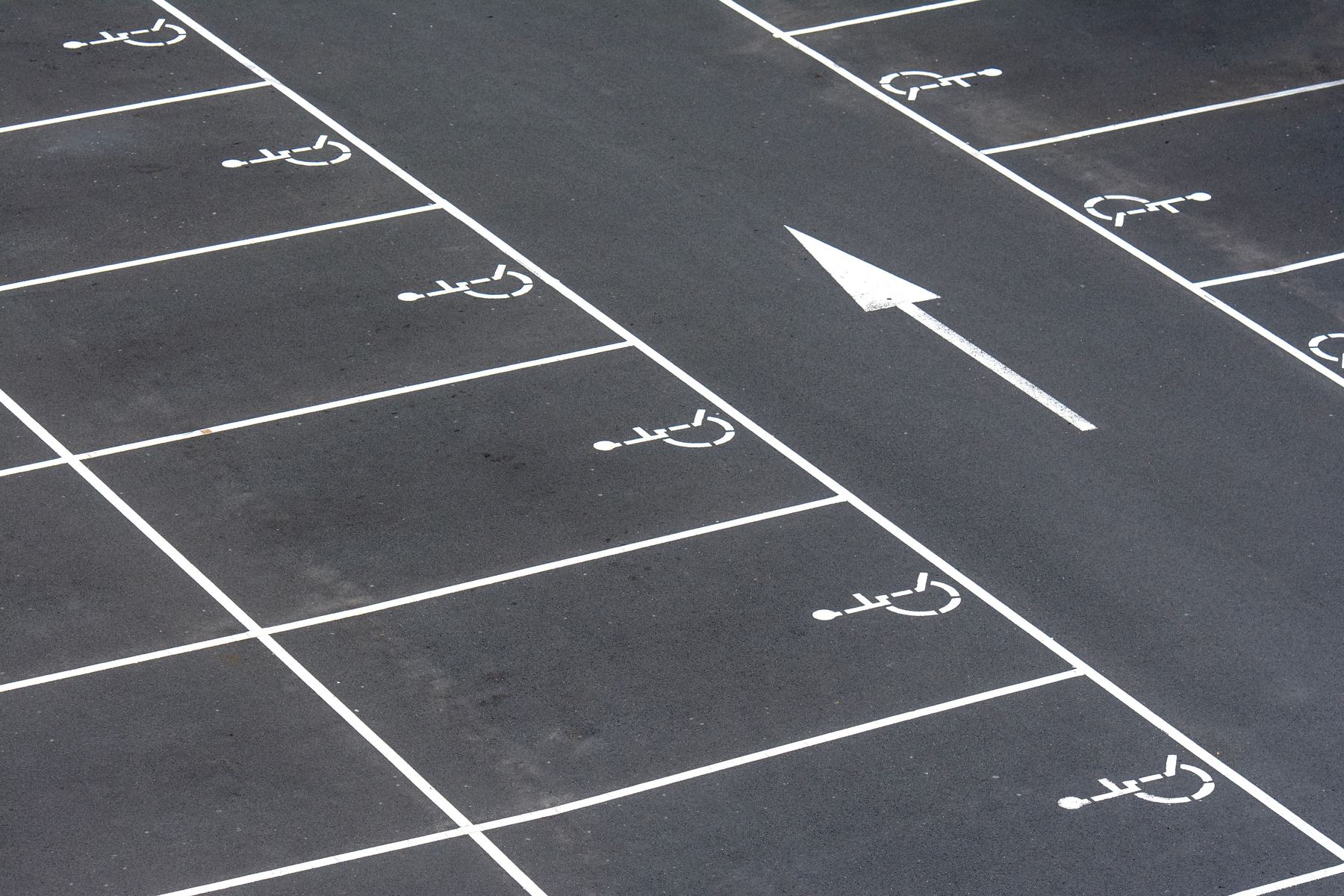
The 2010 ADA Standards for Accessible Design set rules for the accessible spaces and the aisles beside them. Several of those rules come down to how the asphalt is graded and marked.
How Many Accessible Spaces a Lot Needs
The number follows the size of the lot. Under Table 208.2, a lot with 1 to 25 spaces needs one accessible space, 26 to 50 needs two, 51 to 75 needs three and 76 to 100 needs four.
At least one of every six accessible spaces must be sized for a van. Car spaces must be at least 96 inches wide and van spaces at least 132 inches, each with a marked access aisle at least 60 inches wide beside it. A van space can be 96 inches wide when its aisle is also 96 inches.
The Access Board’s guide adds that accessible spaces must sit on the shortest accessible route to an accessible entrance. That decides where they go on the paving plan.
Slopes No Steeper Than 1:48
This is where grading and accessibility meet. Section 502.4 says accessible spaces and their access aisles must be level with each other, with slopes no steeper than 1:48, which is about 2 percent.
The advisory note explains why: the aisle has to be nearly level in all directions so a person can move between a wheelchair and a vehicle, and the small allowance is there so water can still drain. The Access Board’s guide says the slope limit applies to the accessible spaces, aisles and routes, not to the whole lot.
On a flat New Orleans site, that balance takes planning. The drive lanes can carry the fall toward the drains, while the accessible area stays within its limit.
When Resealing Counts as an Alteration
This one surprises many property owners. The Access Board’s guide says resurfacing or resealing a lot counts as an alteration, and an alteration must include the accessible spaces the scoping table calls for.
The same guide says normal maintenance, such as pothole repair, surface patching or repainting existing striping in place for a few spaces, is not an alteration unless it affects how the facility can be used.
So before a full seal coating or overlay, it is worth counting the spaces and checking the accessible ones against the table. Our comparison of sealcoating vs. resurfacing vs. repaving explains how those three jobs differ.
Where New Orleans Business Owners Should Start
The numbers line up behind one idea. Heavy axles wear a lot many times faster than cars, New Orleans rain arrives in large amounts at once, and the accessible spaces have firm limits on size and slope.
A business lot that accounts for all three costs less to keep. One that ignores them tends to fail first along the truck route and around the drains. For a wider look at why asphalt suits a business property in the first place, see our reasons asphalt suits New Orleans commercial properties.
At TurnKey Asphalt, we look at what crosses the lot, where the water goes and how much of it can close at once. On a commercial lot we can work in sections, as our asphalt replacing page describes, so part of it stays open, and we finish with line striping so the lot goes back into use.
Every project starts with a free written estimate that sets out the depth, the phasing and the dates before any work begins.
To talk through your business lot, call us today at (504) 576-9561.
Frequently Asked Questions
Why does a commercial parking lot need thicker asphalt than a driveway?
Because it carries heavier axles, and pavement wear grows much faster than weight. FHWA research says doubling an axle load raises the damage by about 8 to 16 times, depending on the type of damage.
A driveway sees cars. A business lot often sees delivery trucks, garbage trucks and fuel deliveries on a regular route. Depth is set by that traffic, so the truck lane may be built heavier than the customer spaces.
How heavy can a delivery truck legally be?
Under 23 CFR 658.17, which applies to the Interstate System and reasonable access to it, the limits are 20,000 pounds on a single axle, 34,000 pounds on a tandem axle and 80,000 pounds gross.
Trucks that serve local businesses are often lighter, but a loaded tractor-trailer at a grocery or warehouse dock can be close to those limits. Each axle of that size counts for far more wear than a car.
Where does a business parking lot usually fail first?
Usually along the truck route and where heavy loads stand still. The FHWA notes that heavy loads break up pavement in the wheel paths, and standing weight dents a surface faster than moving weight.
Low spots near drains are the other common place. Water that sits there softens the base, and cracks and potholes follow.
Does the City of New Orleans regulate parking lot stormwater?
Yes, for larger projects. The city’s Stormwater Code covers new development or redevelopment, other than smaller residential properties, with 5,000 square feet or more of impervious surface or a site of one acre or more.
Those projects must retain or detain and filter the first 1.25 inches of each rain and limit the runoff rate. The Department of Safety and Permits decides whether a plan is needed when the building permit is submitted.
How much rain does a New Orleans parking lot have to handle?
NOAA’s Atlas 14 puts a one-hour storm of about 2.03 inches at roughly once a year on average in New Orleans, and about 3.34 inches for the 10-year one-hour storm.
On a one-acre lot, the yearly storm is roughly 55,000 gallons of water in an hour, by our math. That is why the levels have to carry water to the drains.
How many accessible parking spaces does my lot need?
Table 208.2 of the 2010 ADA Standards sets the count by lot size. A lot with 1 to 25 spaces needs one, 26 to 50 needs two, 51 to 75 needs three and 76 to 100 needs four.
At least one in every six accessible spaces must be van accessible. The spaces must also sit on the shortest accessible route to an accessible entrance.
What is the maximum slope for an accessible parking space?
The 2010 ADA Standards allow slopes no steeper than 1:48, about 2 percent, in accessible parking spaces and their access aisles. The aisle must also be level with the space it serves.
The Access Board’s guide says that limit applies to the accessible spaces, aisles and routes, not to the whole lot. The rest of the lot can carry more fall toward the drains.
Does sealcoating my lot trigger ADA requirements?
According to the US Access Board’s guide, resurfacing or resealing a lot counts as an alteration, and alterations must include the accessible spaces the scoping table requires.
Normal maintenance, such as pothole repair, patching or repainting existing striping for a few spaces, is not treated as an alteration unless it affects usability. It is worth checking the accessible spaces before a full reseal or overlay.