

Slidell grew up on the first high ground north of Lake Pontchartrain, about three miles from the shore and surrounded by rivers and bayous. The ground looks sandy and dry. A foot or so down, for part of every year, it is neither.
A sandy yard gives the impression of ground that drains well. In much of Slidell, that impression does not hold up, and the driveway is often the first thing to show it.
The soils under most of the city are fine sandy loams with a water table that rises close to the surface in late winter and spring. A driveway base sitting in that wet layer loses support, and the asphalt above it follows.
At TurnKey Asphalt, we look at what is under a driveway before we talk about what goes on top of it, because that is where most Slidell problems start.
If your driveway has dips, ponding or patches that keep failing, contact us and we will tell you what is behind them.
This guide covers where Slidell sits, what its soils do under pavement, the signs to watch for, and how each problem is usually repaired.
Where Slidell Sits and Why It Matters for Pavement
Slidell’s setting explains a lot about the ground under its driveways. The city’s own history page lays out how it came to be where it is.
First High Ground North of the Lake
According to the City of Slidell, the town began to grow around 1882, when the New Orleans and Northeastern Railroad set up a 70-acre construction site at the first high ground north of Lake Pontchartrain. That site grew into the city.
The town grew steadily from there. The city puts its population at 364 in 1890 and 24,142 in 1990.
“High ground” is relative here. It is higher than the wetlands around it, but it is still flat, low land with water close by on several sides.
Rivers, Bayous and a Lake Three Miles Away
The city describes Slidell as about three miles from the north shore of Lake Pontchartrain and surrounded by rivers and bayous. Water is never far from any lot in town.
That shapes how the city handles drainage. Slidell’s Bridges and Drainage Division cleans storm drains, catch basins, culverts and roadside ditches, and cleans and reshapes the city’s major drainage canals on an 18-month cycle.
A City That Grew Fast in the 1960s and 1970s
The city credits NASA with its jump to city status. More than 15,000 NASA employees and their families came to the area in the early 1960s.
In that decade, Slidell became the middle of three local sites in NASA’s lunar landing program, between the Michoud Assembly Facility in New Orleans East and the Mississippi test facility now known as Stennis Space Center. A large NASA computer complex was built in Slidell itself.
The Census Bureau’s housing data shows the result. Slidell’s median home was built in 1979, and about 47 percent of its roughly 12,203 housing units were built between 1960 and 1979, a third of them in the 1970s alone.
Katrina and the Years Since
The city’s history also records that Hurricane Katrina devastated Slidell on August 29, 2005. If your driveway dates from before 2005, it is worth finding out what it went through that year and what was done to it afterward. A surface laid over storm damage can hide a weak base for years.
What Slidell’s Sandy Loam Does Under a Driveway
We ran the USDA soil survey for St. Tammany Parish against the Census Bureau’s boundary for the city of Slidell. Two soil series cover most of the land.
Myatt Fine Sandy Loam Across Most of the City
About 55 percent of the land inside city limits is mapped as Myatt fine sandy loam. The USDA describes the Myatt series as very deep, poorly drained, moderately slowly permeable soils with very slow to slow runoff. The series forms on stream terraces and upland flats, the same kind of level ground the city was built on.
Its rating for building local roads and streets is “very limited,” and the only reason given is depth to a saturated zone. That rating is about water held in the soil.
Stough Soils and the Thin Cemented Pan
Another 31 percent or so is Stough fine sandy loam. The USDA puts Stough’s seasonal high water table at 1 to 1.5 feet below the surface during the wet season, late in winter and early in spring.
Stough is also rated “very limited” for local roads. Along with the saturated zone, the rating lists depth to a thin cemented pan as a second limit.
Flood-Prone Myatt and Prentiss Areas
Not all Myatt ground is the same. About 14 percent of the city’s land is mapped as a separate unit, Myatt fine sandy loam, frequently flooded, which the soil survey names for exactly that.
Another 7 percent or so is Prentiss fine sandy loam. A single subdivision can cross more than one of these soils, so two driveways on the same street can age differently.
Why Sandy Does Not Mean Well Drained
Both main soils are mapped at 0 to 1 percent slopes, so rain that soaks in has little fall to carry it away. When the water table rises to within a foot or so of the surface, the driveway base sits in or just above wet soil.
So the support under a Slidell driveway can change with the season. A surface that feels solid in a dry fall is resting on wetter ground by late winter.
Warning Signs on a Slidell Driveway
Each of these points to a different kind of fix. Walking the driveway after a heavy rain shows most of them.
Sunken Areas That Hold Water
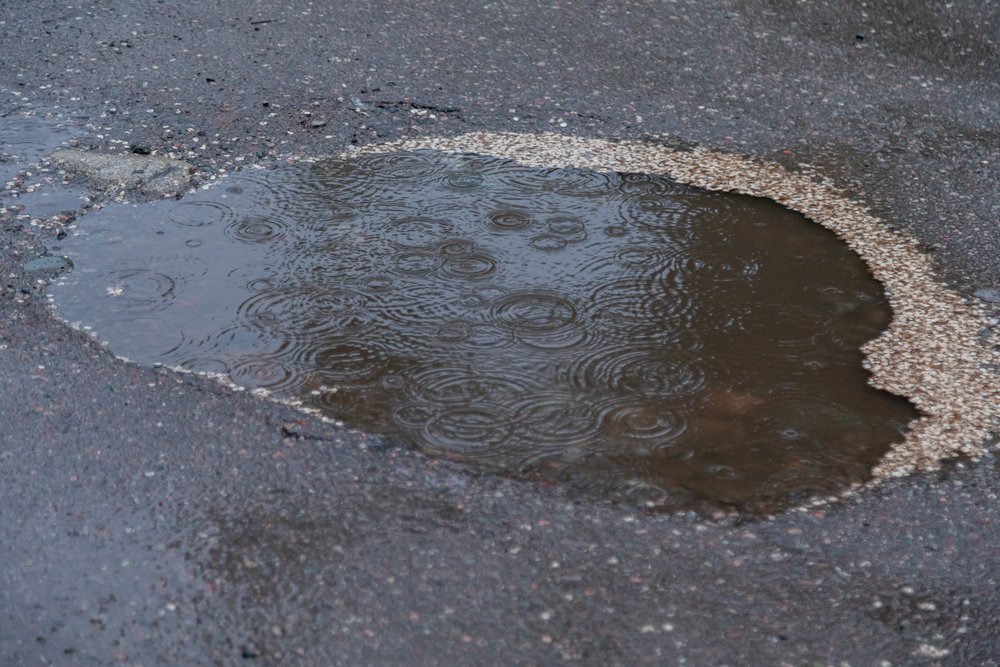 A dip that is still holding water a day after rain is usually a base problem showing up at the surface. Grading that never drained properly can look the same.
Filling the dip without dealing with what is under it puts you back where you started.
A Gray Surface Shedding Grit
Loose grit you can sweep off a driveway that has gone gray is raveling, the surface losing its binder. It is most often caused by sun and age.
On its own, raveling is a case for seal coating, as long as the base is sound. A coat adds no strength and carries no load, so it will not help a driveway that is also sinking.
Patches Laid Over Patches
A driveway with several generations of patches, some of them failing again, is telling you the cause was never reached. Repairs that keep coming back in the same spots are one of the signs that a driveway has moved past patching. Each new patch adds another layer, and none of them fixes the ground below.
Cracks Joining Into a Web
A single crack is a sealing job. Once cracks start joining into a connected pattern, the surface is telling you the layer beneath it is moving. For more on telling these stages apart, see our post on the top signs it’s time to resurface your driveway.
Water Backing Up From the Street
Sometimes the problem starts at the curb, not on the driveway. If the roadside ditch, culvert or catch basin near your driveway is blocked, water has nowhere to go and sits against the pavement edge.
Inside city limits, those are the kind of drains Slidell’s Bridges and Drainage Division cleans. It is worth reporting a blocked one before blaming the driveway for the water.
Comparing Repair Routes for a Slidell Driveway
The right fix depends on where the failure sits. The table matches common Slidell problems to their usual cause and repair route.
| Problem | Likely Cause on Slidell Ground | Usual Repair Route |
|---|---|---|
| Gray surface, loose grit | Binder lost to sun and age, base still sound | Clean, fill any cracks, then seal coat |
| Single cracks | Surface aging or movement that has not yet reached the base | Seal the cracks while they are still single lines |
| A dip that holds water | Base weakened by water in a high seasonal water table | Cut out the area, rebuild the base, repave and seal the joint |
| Webbed cracks or failing patches across most of it | Base failure spread across the driveway | Replace the driveway from the base up |
Localized Repairs That Reach the Base
For a dip or soft area in one part of the driveway, our asphalt repair work cuts the failed area back to sound asphalt, takes out anything soft underneath and rebuilds the base before new asphalt goes down. The joint around the patch is sealed so water has no way back in at the edge.
Why a New Top Layer Is Not Enough
Laying fresh asphalt over a driveway that has failed underneath buys very little, as our asphalt paving page explains. A new layer does nothing for wet, weak ground beneath the old base.
Our comparison of sealcoating vs. resurfacing vs. repaving walks through when each surface option makes sense.
Set the Levels Before the Asphalt
On flat ground, the finished levels decide whether rain runs off or sits. We set them while the base is being built, before any asphalt arrives, because once the surface is down they cannot be changed without taking it up again.
Check With the City Before Major Work
The City of Slidell’s engineering department handles permits for paving, stormwater, utility and other development work through its online portal. If you live inside city limits and are planning more than routine upkeep, check with the city first.
The same department reviews new development plans for compliance with the city’s drainage and flood control regulations.
What This Means for Your Slidell Home
A Slidell driveway sits on sandy loam that holds water close to the surface for part of every year, on flat ground with water on several sides. Nearly half of the homes beside those driveways went up between 1960 and 1979, and the city came through Katrina in 2005.
None of that makes a lasting driveway out of reach. NOAA’s normals for the Slidell airport station put rainfall at 61.88 inches a year, so the work has to start with the base and the levels, with the surface last.
At TurnKey Asphalt, we look at the base before we quote and tell you plainly whether a repair will hold or the driveway needs rebuilding. Every project comes with a free written estimate. For how long a well-built surface can last, see our guide to understanding asphalt lifespan.
Our Slidell asphalt service page covers everything we do in the city.
To have your Slidell driveway looked at, call us at (504) 576-9561.
Frequently Asked Questions
What soil is under most of Slidell?
The USDA soil survey maps most of Slidell as fine sandy loam. By our count, about 55 percent of the land inside city limits is Myatt fine sandy loam and about 31 percent is Stough fine sandy loam. Smaller areas are mapped as Prentiss fine sandy loam and as Myatt soils that flood frequently.
Does sandy soil in Slidell drain well?
Not always. Myatt soils are poorly drained, and Stough soils have a seasonal high water table 1 to 1.5 feet below the surface in late winter and early spring. The USDA rates both “very limited” for local roads because of that saturated zone.
Why does my Slidell driveway get worse in spring?
That is when the Stough water table sits highest, according to the USDA. A driveway base sitting in or near wet soil has less support during those months.
How old are most Slidell homes?
Census data for 2020 to 2024 gives a median year built of 1979 for Slidell. About 47 percent of the city’s homes were built between 1960 and 1979, and a third were built in the 1970s alone.
Will seal coating fix a dip in my driveway?
No. Seal coating protects a surface that is still sound, and it adds no strength and carries no load. A dip that holds water usually needs a repair that reaches the base.
Do I need a permit to pave a driveway in Slidell?
The City of Slidell’s engineering department takes paving, stormwater and utility permit applications through its online portal. Check with the city before major work inside city limits so you know what applies to your project. If your home has a Slidell address but sits outside city limits, check with St. Tammany Parish instead.
Who maintains drainage on Slidell streets?
The city’s Bridges and Drainage Division cleans storm drains, catch basins, culverts and roadside ditches, and cleans and reshapes the major drainage canals on an 18-month cycle. The Streets Division maintains the city’s asphalt streets. Your own driveway, from the street edge to the garage, is yours to look after.
Should I repair or replace my Slidell driveway?
It depends on how far the damage has spread. Dips or soft areas in one part of the driveway can usually be repaired from the base up, while webbed cracking or failing patches across most of it usually point to replacement.