(504) 576-9561
Free Estimate!
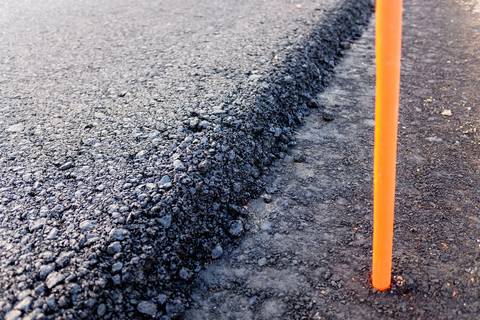
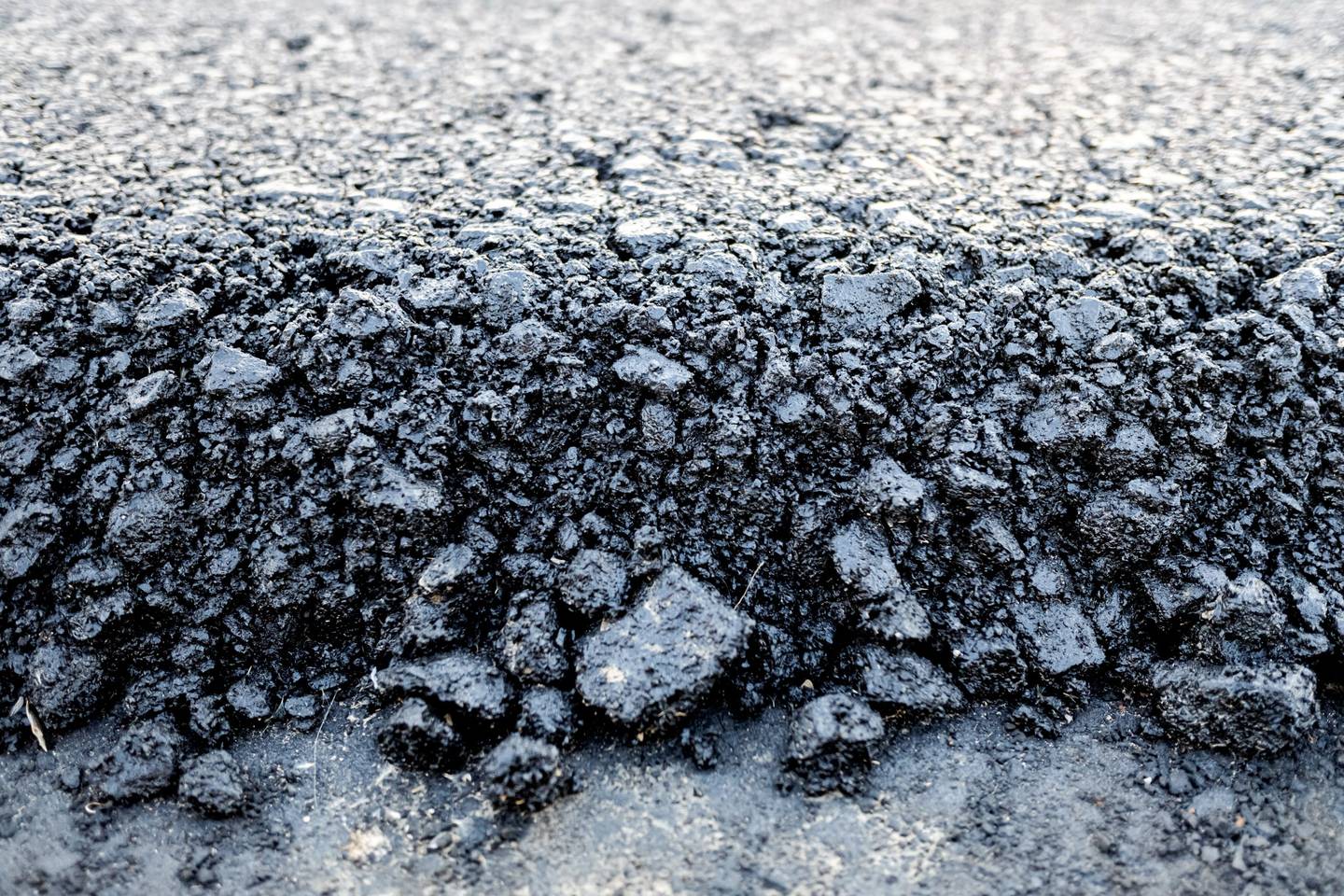
Cracked and deteriorated asphalt pavement in close crop

New Orleans metro

Asphalt Repair in New Orleans, LA

Tell us the surface and the square footage and the job gets priced properly instead of guessed at. We are fully licensed, bonded, and insured.

Asphalt Repair

What Asphalt Damage Do We Repair in New Orleans?

We repair the four ways asphalt commonly fails in New Orleans: cracking, potholes and broken edges, sunken or settled areas, and raveling. Each one points at a different fix, so we look first at whether the damage is still sitting on the surface or has already reached the base underneath.

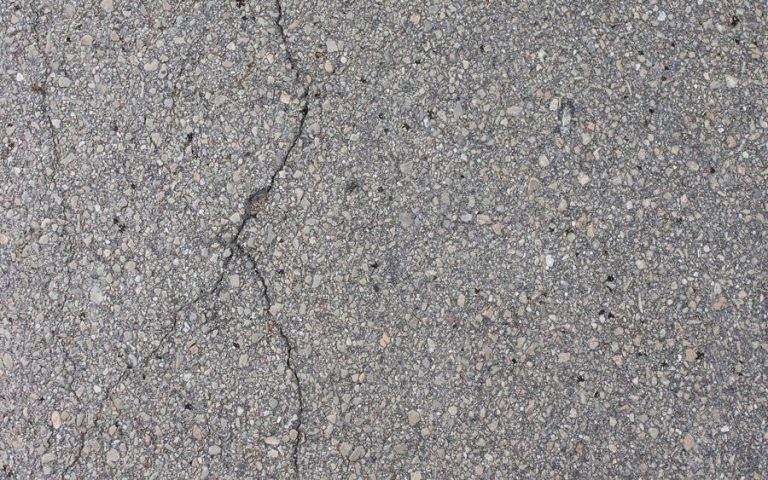
A crack running through an asphalt surface, with the aggregate visible around it

Cracks That Have Opened Up

A single crack like the one pictured is a route for water. Sealing it while it is still narrow is the least involved work we do, and it is what keeps the rest of this list away. Once separate cracks start joining into a connected pattern, the surface is telling you the layer beneath it is moving.
Potholes and Broken Edges

A pothole usually starts as a crack that was left alone. Water works its way down, the base beneath softens and loses strength, and traffic breaks the surface apart once the support underneath is gone. Edges go the same way, typically where a driveway meets grass and nothing holds the asphalt in place sideways.

Sunken and Settled Areas

A dip that holds water after rain is usually a base problem wearing a surface problem’s clothing. Grading that never drained properly in the first place can look the same. Filling the dip without dealing with what is under it puts you back where you started.

Raveling and a Surface That Has Gone Gray

Raveling is the loose grit you sweep off a driveway that has lost its binder, most often to sun and age, though poor compaction when it was laid can start it early. On its own it is a case for seal coating rather than repair, and catching it at that stage is the difference between a coat and a repave.

Asphalt Repair

When Is a Repair Still the Right Answer?

A repair is still the right answer while the failure is confined to defined areas and the base under it is sound. The moment water has been getting past the surface long enough to soften what is underneath, patching the top is a holding measure rather than a fix. This is a question we would rather answer honestly than sell around.

If your surface sits somewhere in between, we will say so and explain what each option involves before you decide.

What Points Toward a Repair

Damage in defined areas rather than across the whole surface, asphalt that is still firm underfoot and holds its shape under a vehicle, water that leaves rather than standing after rain, and cracks that are separate lines rather than a joined pattern.

What Points Toward Replacing It

Cracking joined into a web across large areas, a surface that moves or feels soft when a loaded vehicle crosses it, patches laid over patches failing again, and water sitting in the same places after every rain.

Asphalt Repair

How Do We Repair Asphalt, Step by Step?

We repair asphalt in four steps: assess the whole surface, cut the failed area back to sound asphalt, rebuild the base where it is needed, then lay and compact the new material. The sequence matters more than the material, because a patch that is not cut back to sound asphalt and not compacted properly will lift at its edges no matter what mix goes into it.

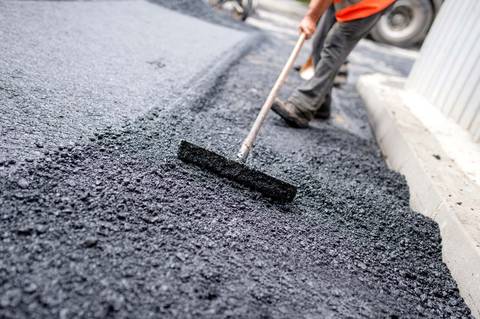
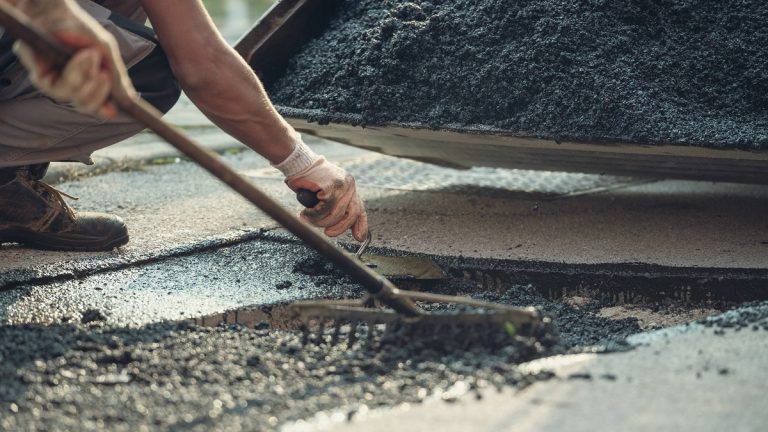
Fresh asphalt being raked level into a cut-out repair

We Look at the Whole Surface First

We check the whole surface, not only the part that is obviously broken. The damage you can see tells us where water has been going, and the surface around it tells us how far it has already traveled.

We Cut Back to Sound Asphalt

We square off the failed area and cut it out past the damage, so the new material sits against solid edges rather than crumbling ones. Anything soft underneath comes out with it.

We Rebuild the Base Where It Is Needed

If the layer under the asphalt has been washed out or has settled, we compact or replace it before we lay anything over it. This is the step that decides whether the repair holds or fails from underneath.

We Lay and Compact the New Material

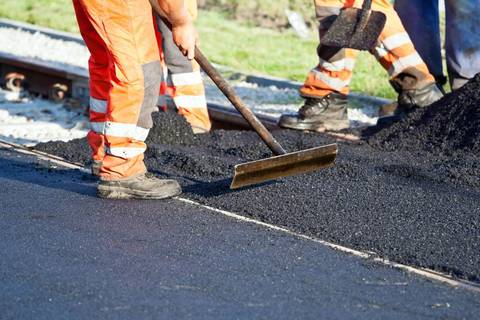
We lay the patch to match the surrounding level and compact it while it is hot, then seal the joint around it so water has no way back in at the edge.

Asphalt Repair

Why Does New Orleans Weather Break Asphalt Faster?

New Orleans weather breaks asphalt faster because heat softens the binder, heavy rain gets under the surface and takes the strength out of the base, and soft ground settles beneath it. These forces work against a surface together rather than in turn.

Heat

Long, hot summers soften the binder that holds a surface together. A soft surface deforms under weight that sits still, so the first marks show where trucks and trailers stand rather than where cars drive over.

Rain

Heavy rainfall finds every opening. Water that gets under a surface and cannot drain away takes the strength out of the base, and the asphalt above it loses its support.

Ground Movement

Much of this area is built on soft ground that settles. A surface can be laid perfectly and still develop dips, so we give drainage and levels as much attention as the mix.

None of that means a surface here has a short life. It means routine asphalt maintenance counts for more here than it would elsewhere, and a small repair caught early is worth a great deal more than the same repair caught late.

Asphalt Repair

What Moves the Price of an Asphalt Repair?

The price of an asphalt repair moves with the measured area of the cut, how deep the failure goes, whether the base has to be rebuilt, access for our equipment, and how much of the surface can go out of use at once. We do not publish a price per square foot for repair work, because the same square foot costs different amounts depending on what is under it. These are the things we measure before we quote.

Measured Area

Not the size of the hole, the size of the sound-to-sound cut around it. That is the area we price.

How Deep the Failure Goes

A surface patch and a full-depth repair are different jobs, and which one you need is decided on site.

Whether the Base Has to Be Rebuilt

Rebuilding the layer under the asphalt changes the scope of the job more than anything else does.

Access and Phasing

What our equipment can reach and what we carry in, and how much of the surface can go out of use at once. On a lot that has to stay open, we work in sections.

You get all of that in writing before anything starts, at no cost. If the honest answer is that a repair will not hold and you are better off with a new surface, that is what the estimate will say.

Asphalt Repair

Where Do We Carry Out Asphalt Repairs?

We carry out asphalt repairs across the New Orleans metro, and each area we cover has a page of its own with the local detail on it. If your property sits on the edge of these areas, call us and we will tell you plainly whether it is in range.

Greater New Orleans

New Orleans, Metairie, Kenner, Gretna, Harahan and River Ridge, across Orleans and Jefferson Parish.

The Northshore

Slidell, Covington, Mandeville and Madisonville, across St. Tammany Parish.

The River Parishes and Baton Rouge

St. Rose, LaPlace, Hammond and Baton Rouge, across St. Charles, St. John the Baptist, Tangipahoa and East Baton Rouge Parish.

Standards

What Do the Asphalt Specifications Actually Say?

Two claims repeated across the paving trade do not survive a reading of the source documents.

A Minutes, not days

Asphalt does not have a cure time. It gains full strength on cooling and can typically support traffic within minutes of construction, and hours only in rare cases depending on lift thickness and ambient conditions. A newly built two inch surface is generally a few minutes.

B A few days is advice

The association guidance still recommends waiting a few days before opening a new residential driveway, and keeping a heavy moving truck off a fresh mat. That is best practice advice about protecting a new surface, not a curing requirement.

C No single minimum temperature

The minimum is set by lift thickness and mix type in the governing specification. Colorado DOT Table 401-3 sets 60 F for a top layer under 1.5 inches, 50 F from 1.5 to under 3 inches, and 45 F at 3 inches or more. Tennessee DOT Table 407.09-1 as revised 12-27-23 sets 45 F unmodified and 55 F modified under 2.0 inches, and 35 F at 2.0 inches or more. Neither of those is Louisiana's specification.

D Do not seal a new mat early

A well designed low traffic pavement should not require sealing for approximately 2 to 5 years, and the association guidance is not to apply sealer until the driveway is at least several months old.

Not claimed here: 3 to 7 days before traffic

Widely repeated, but every page carrying it was a paving company's own marketing or a content site, and the Asphalt Institute contradicts the framing outright. It does not appear on this page.

Not claimed here: 50 F is the minimum

Repeated as a flat rule. The two state specifications read in full show the minimum is thickness and mix dependent, and those two specifications do not even agree with each other.

Ready for a Free Asphalt Repair Estimate in New Orleans?

Tell us the surface and the square footage, and the job gets priced properly instead of guessed at.

Driveways

Residential drives across the New Orleans metro, measured and quoted on the surface you actually have.

Parking lots

Commercial lots, surfaced and graded so water leaves them, then kept that way.

Every area we cover

Each area has its own page, written from its own facts. The service areas page goes straight to any of them.

Get a Free Estimate

Tell us about the driveway or the lot. We reply during business hours, Monday to Friday.

Form not loading for you? The number works just as well: (504) 576-9561, Monday to Friday, 8 AM to 5 PM.